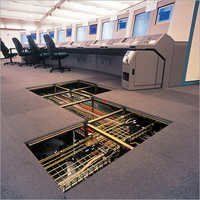
 What is the Finished Slab Height?
The finished floor height is called the distance between the floor and the top surface of the floor panel.
When Is Belt Used?
According to international application standards, it is recommended to use a belted infrastructure system in applications with a finished floor height of 20cm or more. As the floor legs rise, the force created by the horizontal movement of the static and dynamic loads on the feet increases. In order to increase the resistance against this force, the legs are connected to each other with straps and the resistance of the system against horizontal loads and seismic movements is increased. The use of belted infrastructure also increases the point and uniformly distributed load carrying capacity of the system. For this reason, a belt can also be used in systems with a finished floor height of less than 20cm in order to provide the load carrying capacity calculated during project design.
At Which Stage To Start Raised Floor Application?
Raised floor systems are one of the last fine work items in a construction site’s work schedule. After the raised floor application is completed, the middle partition over the floor should be manufactured, furniture should be placed, free-standing tile coverings should be made, if any, and the project should be put into use. Before the application of raised floor systems begins, installations such as suspended ceiling, indoor and underfloor electricity, fire extinguishing, air conditioning (pressure and liquid tests have been completed), plaster and paint applications should be completed except for the final coat paint. Otherwise, even if the raised floor panels are meticulously in the construction site environment, the system will be damaged, and the leveling of the panels is damaged as a result of the removal of the panels in an improper manner (Especially the panels with the factory pressed coating are damaged in the construction site environment, the panels have to be changed completely because the coatings cannot be modified).
For example;
– If the fire extinguishing system, whose pressure test is not completed, leaks when water is supplied to the installation, the raised floor systems will be affected by the water that will flow, especially the chipboard core panels will expand due to moisture and become unusable.
– In a construction site where gypsum plaster is not sanded, the dust that will emerge during the sanding to be done after laying will be filled between the floor joints. When the raised floor system, which has a jointed structure, is walked on, it will have a squeaking / sound problem due to these dusts.
How Is The Relation Of Raised Floor Application With Other Manufacturing?
Raised floor systems cover the whole floor in dimensions of 60 × 60 cm. For this reason, while designing the installations under the flooring, the projects should be made according to these measurement principles, that is, taking into account that the raised floor legs will be placed every 60 cm, otherwise there are problems such as the displacement of the underfloor installations, extra fabrications, delay or failure of the application. . Before starting the underfloor application projects, the application plan should be taken in the raised floor company and the problematic points should be determined by superposing with the projects where the underfloor installations are located.
In projects where the raised floor system will be applied, the floor should be studied on a single reference basis. Before starting the application of underfloor installations, reference axes in the x-y direction of the raised floor system should be determined and marked on the spot. It should be taken into consideration that there will be an infrastructure leg in 60cm from these reference axes and it should be taken into consideration in field application.
Before the raised floor system is designed, the height required for the installations in the underground space must be calculated. The usage area that will remain under the raised floor system is calculated by not deducting the core thickness from the finished floor height and the belt thickness, if any. If the space under the raised floor system is not enough or more, the finished floor height should be revised accordingly. The healthiest method to determine the height of the finished slab is to reference the +1.00 elevation. In this way, it is studied from a single reference and height problems to be encountered during application are eliminated.
 Flooring Systems